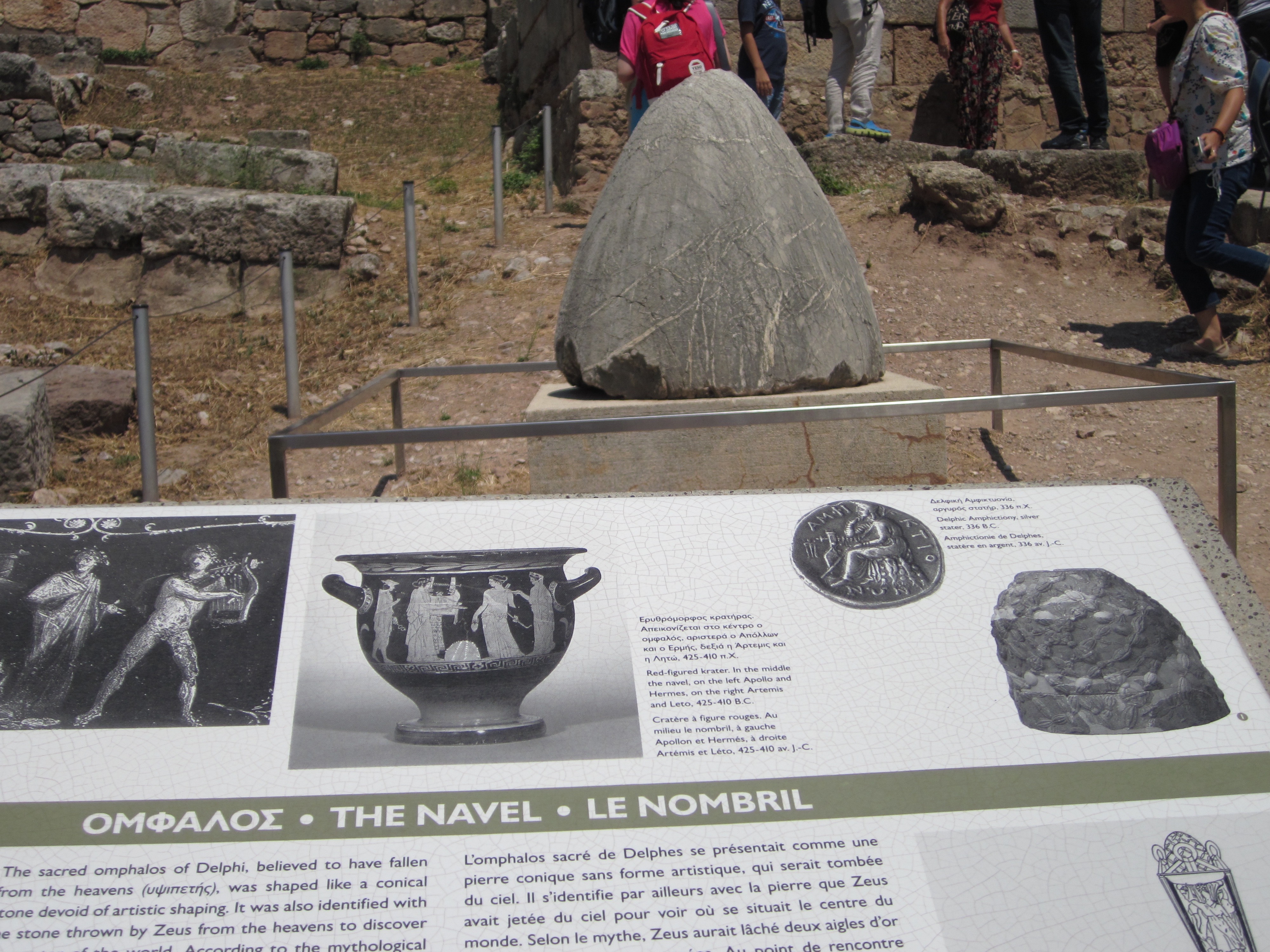
Thank you, Casey Kasem! That’s right, folks, and I don’t mean Delphi, Indiana, although I’ve been there too. Located three hours northwest of Athens, and tucked into the southern slope of Mount Parnassos, out of view from marauding ships, sits the spiritual center of the Greek universe. There is a myth where Zeus sent two eagles to find the center of the world, so he released them at opposite ends, and this is where they met. That’s why Delphi is known as “the navel of the Earth,” and here’s the physical representation, the omphalos. It’s an “outie” with a hole in the top.
 Delphi’s glory began in Mycenaean times, but it really started rocking when the cult of Apollo developed here around the 8th century BCE, and the first temple was built. I say first temple because it was just a hut, but like the story of the Three Little Pigs, that wasn’t good enough. So a second mythical temple was built of wax and feathers but, you guessed it, it didn’t last. The third temple was made of bronze, and I don’t know why that one didn’t make the cut, but the fourth one was built of limestone around the 4th Century BCE, and that one seemed to work pretty well. All this reminds me of “Swamp Castle.”
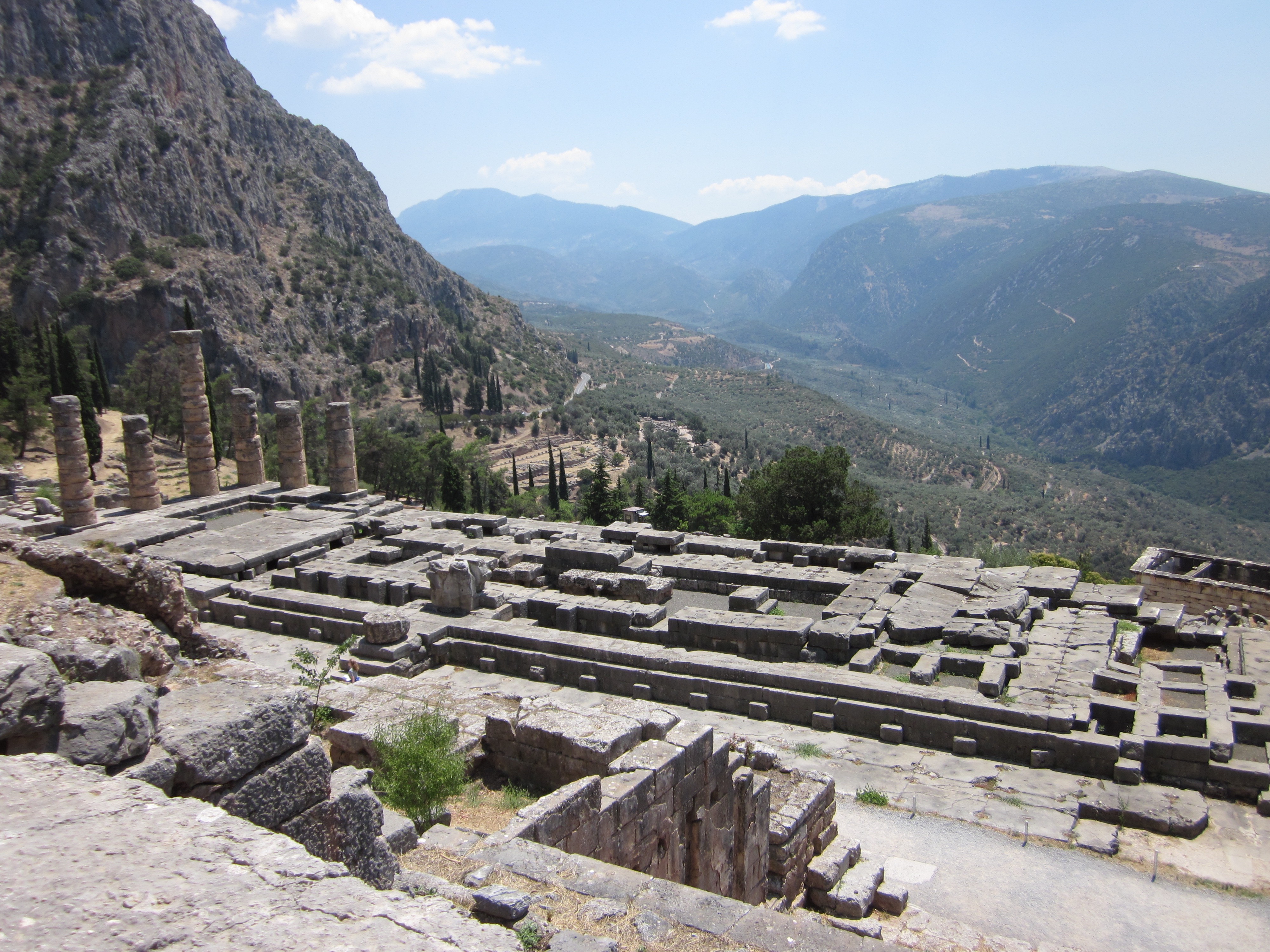 Prophesying was a fairly good business at the time, and the Oracle at Delphi was the best! Apollo “spoke” directly through the Pythia, a woman over fifty who gave up her family to devote all her time to the god. The process itself was fascinating.
First you had to pay a fee and sacrifice an animal, then you drew lots, and came back at the appropriate day and time. Certain citizens had special preference, like getting a Fast Pass at Disneyland. The Pythia and her priests would have cleansed themselves at dawn in the nearby Kastalian spring, then she’d take her place in the temple behind a curtain like the Wizard of Oz. You’d pose your question to the priests, who would pass it on to the Pythia, who shrieked, shouted, and mumbled incomprehensible words in her trance. The priests dutifully translated the utterances, and gave you your answer in writing. Sounds like a lot of hassle when now you can go down to Venice Beach and give $10 to a lady sitting under an umbrella, huh?
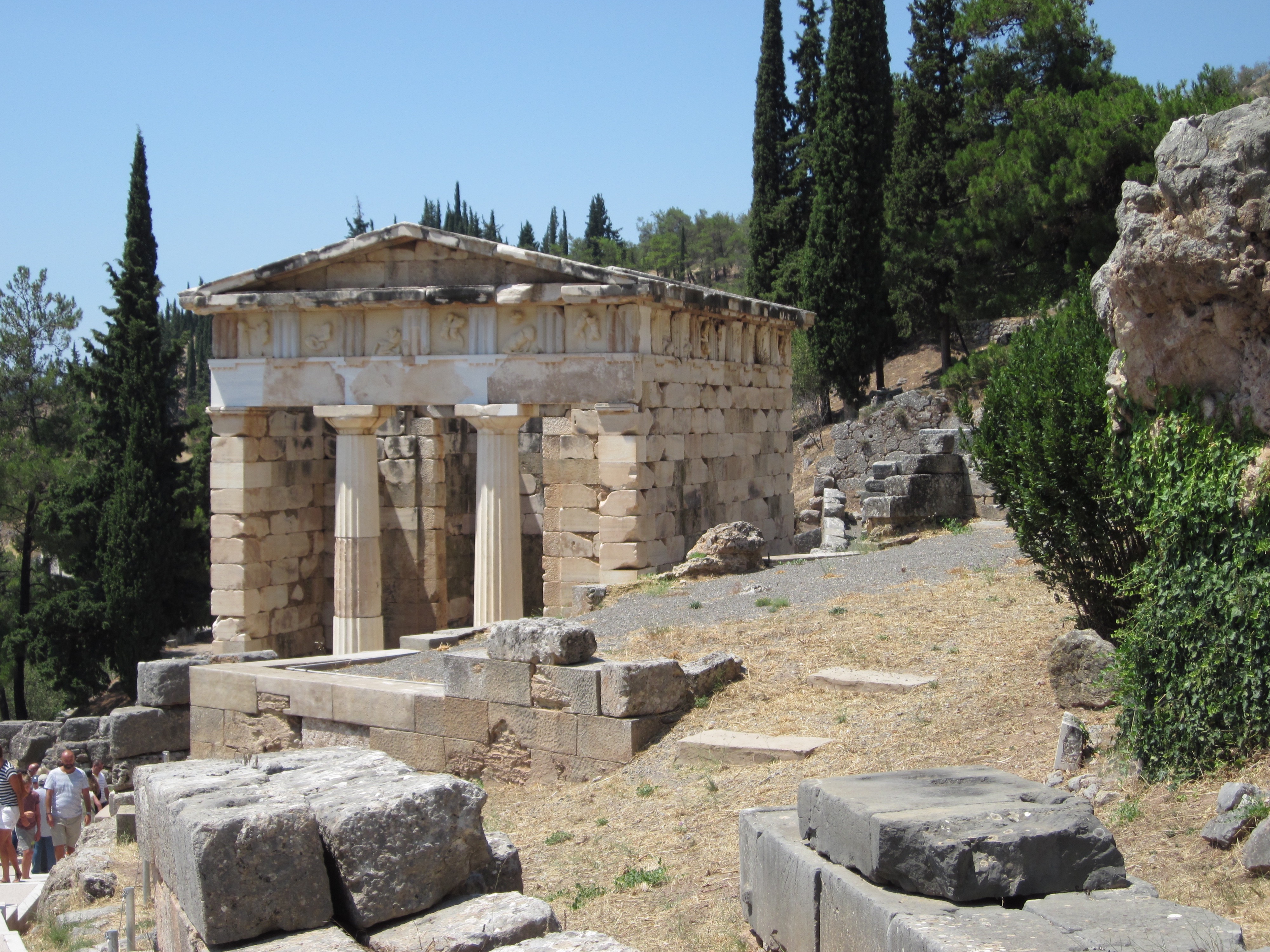
Initially there was only one Pythia, and she only prophesied on Apollo’s birthday (sometime around the 7th of February or March.) Later on she worked full time, and as her notoriety grew, two more employees were added, and then they started franchising to other local areas based on supply and demand. Just like the 700 Club, the money came pouring in, so they built a Treasury. This has been fully restored on the site, and you can tell from the different colored stones.
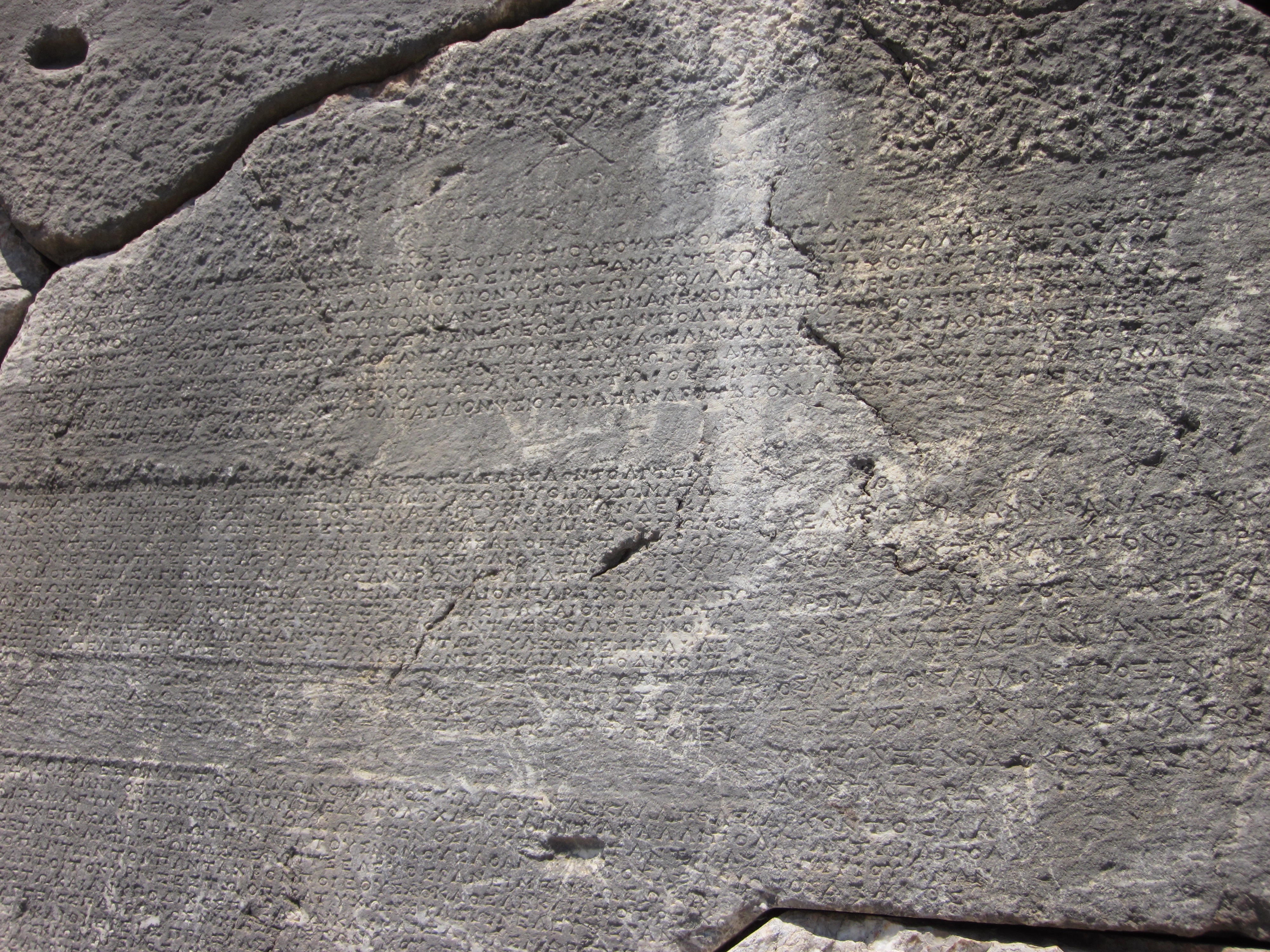
 If you didn’t have any gold, you could also set one of your slaves free as an offering. You’d carve the slave’s name into the stones surrounding the foundations of the temple and off he or she would go. Slavery was huge at the time from all of the military conflicts between different countries and even among the Greeks themselves. Prisoners of war were sold at market, and became farmhands or household servants. The stone below has thousands of names on it.
 Also on the hillside far below the temple of Apollo are a gymnasium and a small sanctuary dedicated to Athena. The gymnasium was used for military training, and training for the Pythian Games which grew out of that training and took place in the stadium at the top of the hill above the theater. A couple next to me was contemplating walking down to it and the conversation went something like this:
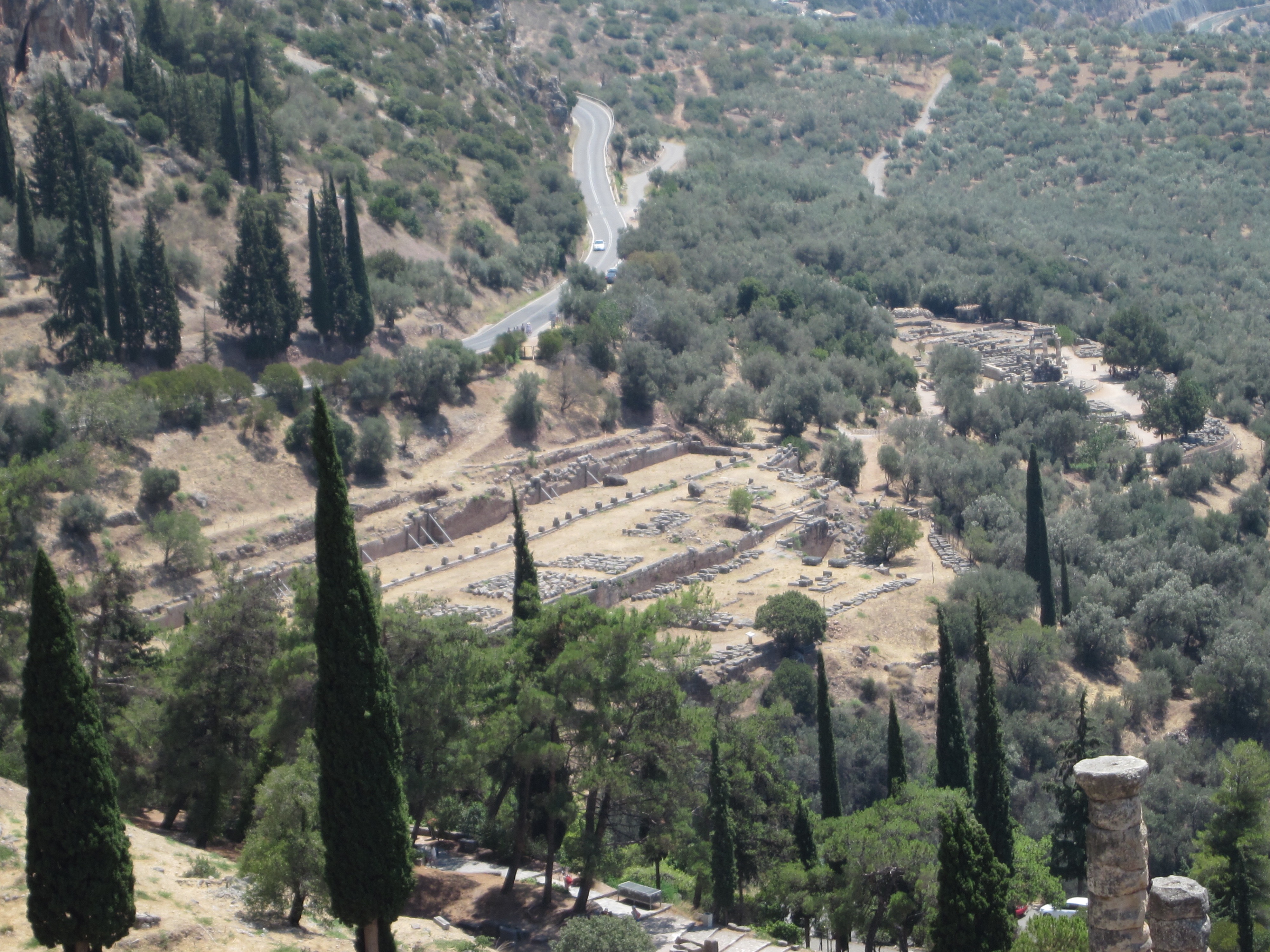
Wife: “It’s so hot! After that hike we just took to see the stadium, I don’t think I could bear it.”
Husband: “Yeah, you’re right. It is awfully far away, and I don’t know if it would be worth it.”
Me: “You see, even back then people were probably making excuses not to go to the gym.”
In fairness, it was sweltering that day and there was no breeze, so I didn’t manage to make it to that site either. At this point Dani and Susan were sitting under a tree in the shade. And now, the moment you’ve all been waiting for, the theater!
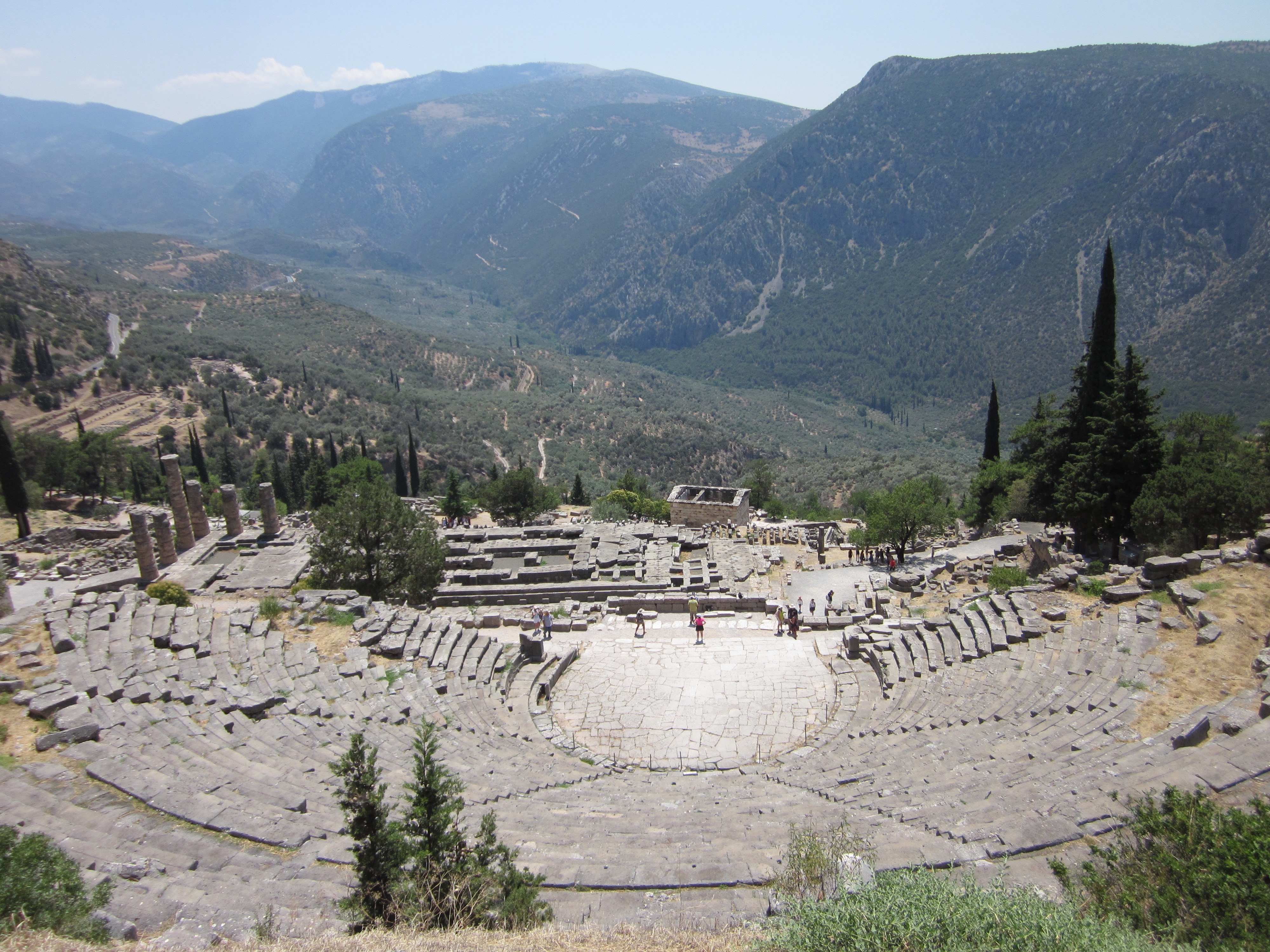
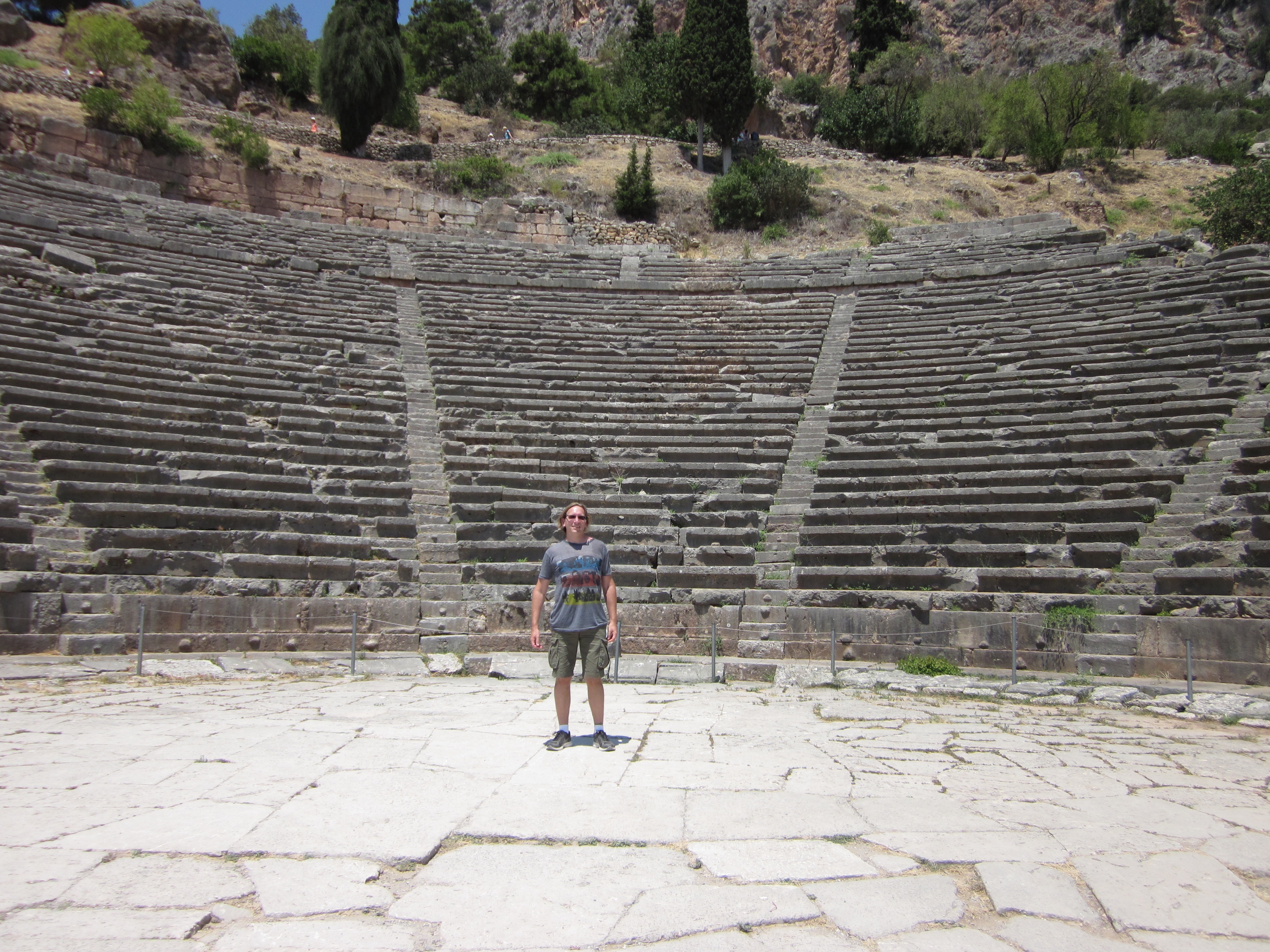
It was built of stones from Mount Parnassos in the 4th century BCE to replace an earlier wooden one, and was then enlarged in the 2nd century BCE. It seats around 5,000 spectators. You can tell it is “newer” than the theater at Epidaurus because the orchestra isn’t a full circle, but the diameter is wider. The area for the skene or “scenery building” is rather small, and was probably somewhat low to allow the audience a better view of the surrounding landscape. By this point in history, the proskenion had also developed, moving the main playing area from the orchestra to today’s “stage.” I suspect they had the ability to cover it like the Romans did with an awning, although I didn’t look for evidence of this while I was there.
I’m sorry if this blog entry has taken a technical turn, but my experiences here have really filled in the gaps from that perspective, and have helped me draw a clearer line through the evolution of the physical theater. Most of the dots have now been connected for me so I can see the big picture and show that picture to the kids better than I could before.

 Mr. Frank in Athens